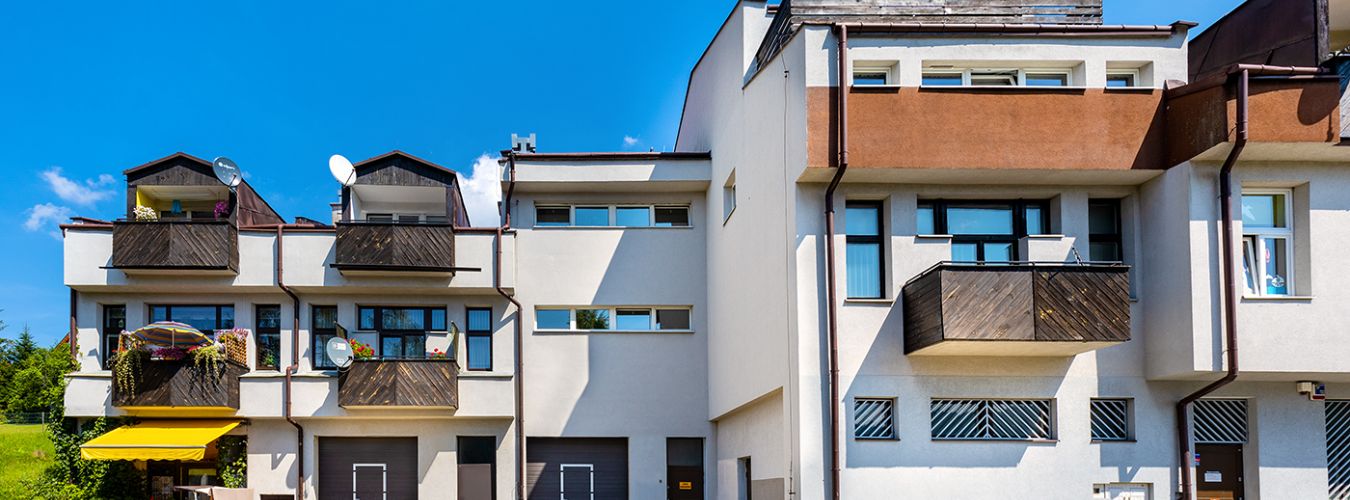
What is a commercial premises? Definition and characteristics
The Civil Code does not precisely define what constitutes commercial premises. However, a definition can be found in the regulation of the Minister of Infrastructure on the technical requirements that buildings and their locations must meet.
According to the regulation, a commercial premises should be understood as "one room or a set of rooms, separated by permanent building partitions, not constituting a flat, technical room or utility room".
The previous Act on Ownership of Premises also refers to "premises for other purposes" in addition to "independent residential premises." This purpose is most often defined as business, although non-commercial activities can also be conducted in commercial premises, and this category also includes buildings belonging to various institutions.
How to check the purpose of a commercial premises?
Before purchasing or renting commercial premises, it's worth checking whether their intended use is consistent with your planned business. The primary source of information is the local development plan (MPZP), which specifies the principles and methods of land development, for example, permitting an office on the property.
You can obtain an extract and a map of the local spatial development plan (MPZP) from the municipal or city office after submitting the appropriate application. This service is usually subject to a fee. Free services, such as Geoportal, also offer preliminary verification of the property's intended use. There, you can verify the plot's location and the applicable planning regulations.
If there is no local spatial development plan (MPZP) in force for a given property, verify the decision on development conditions, which you can obtain from the relevant municipal or city office.
It is also worth asking the property owner or manager for technical documentation of the building and the occupancy permit.
Types of commercial premises
The concept of commercial premises is broad and encompasses properties used in a wide variety of ways. The regulation of the Minister of Infrastructure distinguishes three main types of commercial premises, which must meet different technical requirements:
- office and commercial and service buildings – the broadest category, in which you will find such various commercial premises as offices and practices, shops, catering establishments, production halls and warehouse spaces;
- institutional, cultural, sports and other similar buildings and premises ;
- buildings and premises for short-term accommodation , such as hotels, hostels, guesthouses, campsites and flats and apartments intended for short-term rental.
>> Remember that in many industries, e.g. catering, food, hotel or medical, commercial premises must meet additional requirements specified in separate legal acts.<<
What activities can be conducted in commercial premises?
The scope of activities that can be conducted in commercial premises depends primarily on its intended use and applicable regulations. Such premises are most often adapted as service buildings or intended for office use. They can house, among other things:
- shops,
- beauty and hairdressing salons,
- law firms,
- accounting offices,
- medical offices,
- training facilities,
- restaurants and cafes.
Can you live in a commercial property?
Under Polish law, commercial premises cannot be used for residential purposes , even if their standard and furnishings allow for occupancy without additional work. An exception is short-term rentals, which, in certain cases, may be conducted in accordance with applicable regulations.
Designating commercial premises for long-term residence without changing its intended use may result in legal consequences, including a fine of up to PLN 2,000. The building supervision authority may also order the occupancy of the premises to be suspended until the required formalities are completed and its intended use is changed to residential.
It is worth remembering that commercial premises are subject to higher property tax rates than residential premises.
How to buy commercial premises and what determines the price per 1 m² of commercial premises?
If you're considering purchasing commercial space, first determine your business needs. Consider the location, space, and layout that best suit your needs. Then, determine your budget. Factor in the purchase price as well as additional costs, such as:
- taxes,
- notary fees,
- possible commission,
- expenses related to the renovation or adaptation of commercial premises.
Only on this basis should you start looking for suitable offers.
When analyzing offers, you may notice that prices per square meter of commercial premises vary greatly, although they are usually significantly lower than apartment prices . These prices depend primarily on location. Properties located in attractive locations in large cities will be significantly more expensive than those in smaller towns. Other factors that influence the price include:
- availability of infrastructure in the area,
- room layout,
- type and origin of the commercial premises – primary or secondary market (in this case, the technical condition of the premises is also very important).
Often, a more profitable solution may be to purchase a property from the secondary market, even if it requires significant revitalization and adaptation to the business.
If you're looking to grow your business, check out Orange Real Estate for sale . Our portfolio includes dozens of properties located in various regions of Poland, suitable for retail, service, or office purposes.
What to check before purchasing a commercial property?
Before you decide to sign a sales contract, verify several important issues:
- the legal status of the property – check the land and mortgage register to make sure that the commercial premises are not encumbered with mortgages, easements or other third-party rights;
- the intended use of the premises – analyse the local development plan or the decision on development conditions to confirm that the premises can be used for the planned activity;
- technical condition – verify the condition of the premises, installations and common parts of the building; this will allow you to estimate possible renovation or adaptation costs;
- building documentation – check the occupancy permit and technical documentation to ensure that the premises meet the requirements necessary to run a business;
- maintenance costs – analyze the amount of service charges, administrative rent and other costs related to the use of the property.
A comprehensive analysis of these elements allows you to reduce legal and financial risk and make informed business decisions.
Commercial premises - FAQ section
Can a commercial premises be converted into a commercial and residential building?
Yes, it is possible to convert commercial premises into a mixed-use building , provided applicable regulations and the property's intended use permit. Such a change may require obtaining appropriate administrative decisions and adapting the building to technical and construction requirements.
Is purchasing commercial premises a profitable investment?
Commercial premises can be an attractive investment, especially in locations with high business potential. However, before purchasing, it's worth analyzing the demand for commercial real estate , maintenance costs, and the expected rate of return on investment.
Can commercial premises be rented for any type of business?
Not always. The type of business that can be conducted in commercial premises depends on, among other things, its intended use, the provisions of the local zoning plan, and the requirements arising from applicable regulations.